


Abstract: The WEF (Water-Energy-Food) Nexus perspective has gained prominence in understanding the challenges caused by climate change. In this article, we discuss its proposal and its relationship with the SDGs and present a recent overview of water, energy, and food security in Brazil.
Global climate change (GCC) is the most significant environmental problem of the 21st century. With the exponential increase in Greenhouse Gas (GHG) emissions since the Industrial Revolution, the balance of the Earth System has been compromised. Considering the difference between the countries that have historically emitted the most, such as the United States, and those that currently emit the most, such as China, it is essential to consider that since 1992 the United Nations Framework Convention on Climate Change (UNFCCC) has been the multilateral body within the UN responsible for promoting cooperation to address GCC (Souza, 2024).
Year after year, with the intensification of extreme weather events, such as storms, floods, extreme droughts, etc., the effects of GCC are felt in other areas, such as the reduction of water resources in sufficient quantity and quality, the use of fossil fuels to produce energy and the need to promote a fair energy transition, and the impact on food production in quantity and nutritional quality for the entire planet (Simpson et al., 2022). To deal with the intersection between the challenges in the areas above, the WEF (Water-Energy-Food) Nexus perspective was proposed, a decision-making model that starts from an expanded conception of security, understanding that human security involves not only the State but the protection of communities and individuals against environmental threats, poverty, disease, disasters, armed conflicts, etc. (UNDP, 1994; Souza & Versieux, 2020).
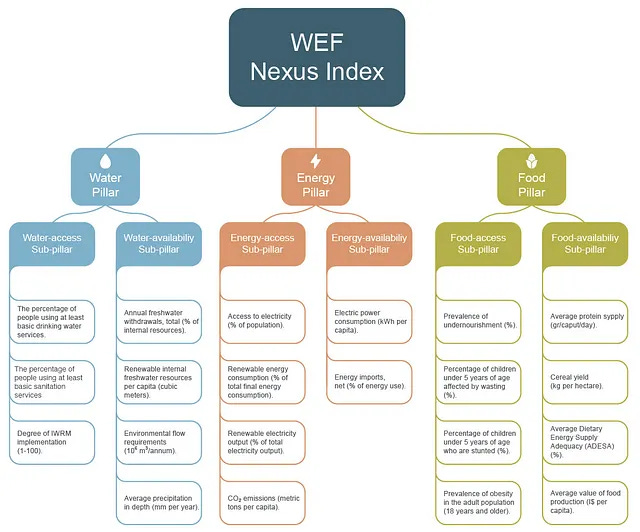
In 2011, researchers developed the WEF Nexus Index with the Water Research Commission, the National Research Foundation of South Africa, and the Ministry of Foreign Affairs of the Netherlands. This tool, which is available for consultation online, involved the creation of a conceptual framework and the proposal of a set of indicators. The platform presents an integrated overview of the WEF Nexus for 179 countries and contains data from 2019 to 2023 (Simpson et al., 2022). Figure 1 presents the index’s three pillars (water, energy, and food) and their indicators.
Figure 1 — WEF Nexus sectors and indicators
Fonte: WEF…, s/p.
The WEF Nexus is directly related to the United Nations Sustainable Development Goals (SDGs), which promote the integrated and sustainable management of natural resources by considering the interdependencies between water, energy, and food (Viana; Silva, 2023). The SDGs emerged in 2015 as a global initiative to promote sustainable development and address urgent challenges, such as eradicating poverty, improving health and education, and addressing climate change (UN, n/d). Regarding its relationship with the WEF Nexus, resource management strategies must be integrated to ensure water, energy, and food security stands out.
Of the three main points the WEF Nexus addresses, targets and indicators can be found in the SDGs. While the Nexus presents the pillars in the water, energy, and food sectors, each with its respective sub-pillars, as highlighted in Figure 1, the SDGs connect these resources and the global goals for sustainable development.
In the case of water, Nexus mainly highlights the management and sustainable access to drinking water and its resources, which aligns with SDG 6 — “Clean water and sanitation.” This SDG, whose subtitle is “Ensure availability and sustainable management of water and sanitation,” seeks to ensure universal and equitable access to drinking water and sanitation, improve water quality, and promote the efficient use of water resources (IPEA, n.d.). The relationship with Nexus is mainly due to the emphasis on providing goals and indicators that can offer solutions for sustainable water management and access to the population.
Regarding the energy sector, Nexus stands out for guaranteeing access to energy, increasing availability, and reducing CO2 emissions (WEF… n.d.). These pillars can also be seen in SDG 7 — “Affordable and Clean Energy.” With the subtitle “Ensure access to affordable, reliable, sustainable and renewable energy for all” (IPEA, n.d.), SDG 7 is related to the Nexus by promoting universal and equitable access to energy, primarily through renewable sources. These aspects clash with the challenges of ensuring energy security and reducing GHG emissions from the energy sector.
Finally, but equally important, the “Food” pillar the Nexus provides establishes a relationship with SDG 2, “Zero Hunger and Sustainable Agriculture.” In its pillars, the Nexus focuses mainly on ensuring access to and food availability for the population. These principles can be observed in SDG 2, which seeks to “End hunger, achieve food security and improved nutrition, and promote sustainable agriculture” (IPEA, n.d.). Both seek to align efforts to ensure that everyone, especially the most vulnerable, has access to food made available by countries.
Like other countries, Brazil faces some challenges in balancing the demands of water, energy, and food management. Although some indicators related to the Nexus, such as access to water and sanitation, have shown progress, the reduction in investments in the sector had a negative impact in 2019, and despite some positive results, the year highlighted structural weaknesses for the sector (IPEA, 2024).
In the energy sector, in 2019, Brazil presented results in line with the Nexus indicators, standing out for the high participation of renewable sources. The domestic supply of energy grew by 1.4%, driven by the expansion of wind, solar, biomass, and biodiesel energy, while the reduction in the use of coal helped maintain the renewable energy matrix, thus reinforcing its positive points for the energy sector (EPE, 2020).
Meanwhile, in the food sector in 2019, relevant actions to promote food security and increase Brazil’s agricultural production stand out. The initiatives included school feeding programs, support for small farmers, and the implementation of sustainable agricultural practices. In addition, the use of data for monitoring and territorial diagnostics was essential to identify accelerators and project future scenarios (United Nations Brazil, 2022).
After a period of discontinuities in implementing government actions aimed at the 2030 Agenda between 2019 and 2022, 2023 marked the resumption of efforts to promote strategic measures for the water sector. This year, Brazil implemented significant changes in legislation and public policies, focusing on restructuring budgets and initiatives to guarantee universal access to treated water and expanding popular participation in various deliberation spaces. The Multi-Year Plan (PPA) implemented indicators such as the proportion of the population with access to water and sanitation, the assessment of the level of water stress by river basin, and the guarantee of water security in strategic territories (IPEA, 2024).
The energy sector for 2023 presented some challenges arising from previous years. There was an increase in electricity tariffs, driven by subsidies paid for via electricity bills, and supply cuts reached the second highest number of the decade. Regarding the energy transition, according to the Luz Report (2024) — base year 2023, there was a small advance, with subsidies for fossil fuels exceeding those for renewable sources. In addition, blackouts and crises exposed the fragility of the infrastructure in the face of climate change, highlighting regional inequalities (GT Agenda 2030, 2024).
Finally, the food sector for 2023 presented a recovery process in policies to eradicate hunger, with emphasis on the reduction of food security for 9.5 million people. Although this progress was observed, the year was also marked by social and political crises and the challenges of climate change, which directly affect the sector (GT Agenda 2030, 2024). In short, the interdependence between the three sectors that Nexus offers becomes fundamental as a model of guidelines for facing the climate crisis and the challenges for countries in their respective sectors. The connection between the UN SDGs and Nexus highlights the need to adopt integrated and coordinated strategies to ensure long-term sustainability in these sectors. In the case of Brazil, despite some advances, such as the greater participation of renewable sources in the energy sector, the implementation of policies for food security, and progress in water management, challenges remain.
Note
This article was produced within the scope of the research “A gestão dos recursos hídricos em Brasil, China e Índia: a atuação dos países emergentes em bacias transfronteiriças dentro do arcabouço internacional de governança hídrica e mudanças climáticas” funded by the Fundação de Amparo à Pesquisa do Estado of Minas Gerais — Fapemig, through the agreement CSA APQ 03349–18, and linked to the Department of International Relations of PUC Minas. And the research: Nexus Water, Energy, Food: challenges for Amazon and La Plata basins’ riparian countries, funded by CNPq — Bolsa de Produtividade; Processo 310017/2021–1.
References
Empresa de Pesquisa Energética (EPE). Relatório Síntese do Balanço Energético Nacional 2020: Ano Base 2019. Available at: https://www.epe.gov.br/sites-pt/publicacoes-dados-abertos/publicacoes/PublicacoesArquivos/publicacao-479/topico-521/Relato%CC%81rio%20Si%CC%81ntese%20BEN%202020-ab%202019_Final.pdf. Access: 11 Feb. 2025.
Grupo de Trabalho da Sociedade Civil para a Agenda 2030. Relatório Luz 2024: A Agenda 2030 no Brasil — Relatório da Sociedade Civil. Available at: https://gtagenda2030.org.br/wp-content/uploads/2024/07/rl-2024-english.pdf. Access: 11 Feb. 2025.
Ipea. Instituto de Pesquisa Econômica Aplicada. ODS 2: Fome zero e agricultura sustentável. Available at: https://repositorio.ipea.gov.br/bitstream/11058/14128/1/Agenda_2030_ODS_6_Assegurar_a_disponibilidade_e_a_gestao.pdf. Access: 11 Feb. 2025.
Ipea. Instituto de Pesquisa Econômica Aplicada. ODS 2: Fome zero e agricultura sustentável. Available at: https://www.ipea.gov.br/ods/ods2.html. Access: 11 Feb. 2025.
Ipea. Instituto de Pesquisa Econômica Aplicada. ODS 6: Água limpa e saneamento. Available at: https://www.ipea.gov.br/ods/ods6.html. Access: 11 Feb. 2025.
Ipea. Instituto de Pesquisa Econômica Aplicada. ODS 7: Energia acessível e limpa. Available at: https://www.ipea.gov.br/ods/ods7.html. Access: 11 Feb. 2025.
Organização das Nações Unidas no Brasil. Relatório Nacional Voluntário sobre os Objetivos de Desenvolvimento Sustentável — Brasil 2019. Available at: https://brasil.un.org/sites/default/files/2021-02/Brasil_Relatorio_Progresso_2019.pdf.
VIANA, Hildebrando Mazzardo Marques; SILVA, Tania Nunes da. Governance of Water, Energy, and Food Nexus for Sustainable Development: a Review of the Literature. Revista de Administração da UFSM, v. 16, p. 1–23, 2023. Available at: https://www.scielo.br/j/reaufsm/a/fhQKKCLyKy9wjmKSxNT33bG/?lang=en. Access: 11 Feb. 2025.
UNITED NATIONS. Sustainable Development Goals. Available at: https://sdgs.un.org/goals. Access: 11 Feb. 2025.
Programa das Nações Unidas para o Desenvolvimento — PNUD. Human Development Report 1994. Nova Iorque: Oxford University Press, 1994. Available at: https://hdr.undp.org/system/files/documents/hdr1994encompletenostats.pdf. Access: 11 Feb. 2025.
Simpson GB, Jewitt GPW, Becker W, Badenhorst J, Masia S, Neves AR, Rovira P and Pascual V. The Water-Energy-Food Nexus Index: A Tool to Support Integrated Resource Planning, Management and Security. Front. Water 4:825854, 2022. DOI: 10.3389/frwa.2022.825854.
Souza, M. de, & Versieux, B. H. Nexo entre água, energia e alimento no contexto das mudanças do clima: o caso do Nordeste brasileiro. Estudos Internacionais: Revista De relações Internacionais Da PUC Minas, 9(1), 112–130. 2021. DOI: 10.5752/P.2317–773X.2021v9n1p112–130.
Souza, Matilde de. Política Ambiental Global e o Brasil. São Paulo: Editora Contexto. 2024.
WEF Nexus Index. Water-Energy-Food Nexus Index. s/p. Available at: https://wefnexusindex.org/.Access: 20 Mar 2024.
WEF Nexus Index. WEF Nexus Index. 2024. Available at: https://wefnexusindex.org/. Access: May 13th 2024.
Allana Camini Moreira: Holds a bachelor’s degree in International Relations from the Pontifical Catholic University of Minas Gerais (2017). Has a master’s degree in International Relations from the same institution (2022) and is currently a doctoral student in International Relations at PUC Minas. She works in the Cross-Border Waters Research Group (FAPEMIG). Has experience in the field of Political Science, with an emphasis on International Politics/International Relations/Energy Matrices and Energy Policies.
Victor de Matos Nascimento: PhD candidate in the Postgraduate Program in International Relations at PUC Minas.