

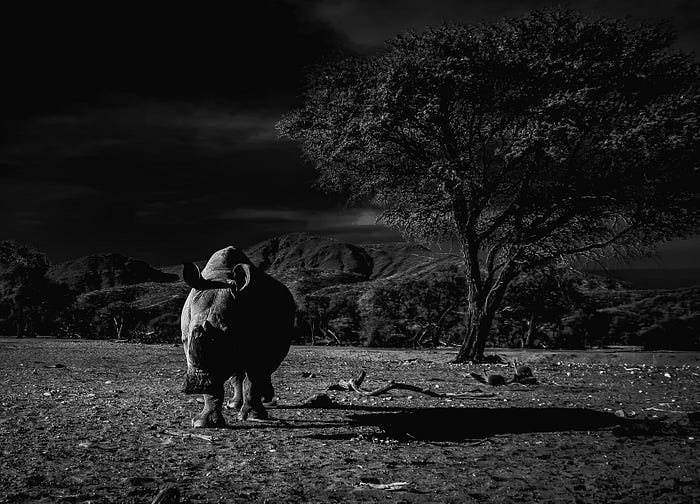
Abstract: This article discusses the worsening of the humanitarian and environmental crisis in Namibia caused by the extreme drought in southern Africa. We highlight the drought’s impact on the population’s food security and the emergency measures adopted by the country’s government to deal with the crisis.
The African continent has approximately 64% of the world’s remaining arable land (Ogega et al., 2024). Much of its soil is rich and fertile, and agriculture is one of the main productive and economic activities. This sector is responsible for generating 60% of jobs across Africa (African…, 2017). Despite this, hunger numbers continue to rise (Ogega et al., 2024).
Data from the Food and Agriculture Organization of the United Nations (FAO) show that malnutrition and food insecurity in Africa are increasing every year. Between 2014 and 2016, 559.7 million people faced one of the two types of food insecurity (moderate or severe). Between 2020 and 2022, this number was 821.5 million, which corresponds to 58.9% of the entire population (FAO et al., 2023).
Although not the only one, climate change is one of the main factors influencing the worsening of hunger and food insecurity in Africa. Alpino et al. (2022) argue that climate change threatens food security as the concentration of greenhouse gases in the atmosphere intensifies, temperatures rise, and climatic events such as droughts become more intense and recurrent. Consequently, food systems’ availability, access, use, and stability are reduced.
In southern Africa, the current situation is a profound environmental and humanitarian crisis due to a long, severe drought that began in October 2023. This is the worst drought in decades in the region (Reuters, 2024). It causes soil moisture deficit, water and vegetation stress, directly affecting agricultural productivity and the energy system, as water scarcity compromises hydroelectric power production (European…, 2024).
The drought in the region has severely compromised agriculture, aggravating food insecurity in the countries. By April 2024, three countries had declared an official state of emergency: Malawi, Zambia, and Zimbabwe (European…, 2024). From April to May, the situation in one country, Namibia, worsened intensely due to extreme drought. In May, 1.4 million Namibians faced severe food insecurity, corresponding to 48% of the country’s population. As a result of the extreme drought, there was a 53% drop in cereal production in the country. This phenomenon has severely affected agriculture, livestock, and the country’s water supply, and water levels in reservoirs have fallen by almost 70%. However, the drought also increased unemployment, impacting the Namibian economy (Relief…, 2024a)
Given the crisis in the country, on May 22, Namibian President Nangolo Mbumba officially declared a national state of emergency. Namibia was the fourth country to declare an emergency due to the drought, the worst in the country in 100 years. In his declaration, Mbumba said: “I at this moment declare that with effect from May 22, 2024, there is a State of Emergency in Namibia due to the persistent national drought disaster that exists in all regions of the Republic of Namibia” (Government…, 2024, p.1).
The severity of the crisis is so profound that one in five Namibians faces food insecurity. In this context, more than 330,000 families have registered with the government-funded drought relief program, whose purpose is to assist communities affected by the disaster (Relief…, 2024b).
To deal with the crisis, the Namibian government has taken emergency measures involving culling wild animals. Around 700 animals will be slaughtered, including elephants, hippos, buffaloes and zebras. This decision was prompted by the scarcity of pasture and water resources, which are no longer sufficient to sustain the local fauna, forcing the government to look for alternatives to feed the population facing severe food insecurity (The New York Times, 2024).
The statement informing of this measure was released by the Namibian Ministry of Environment (MMAN) on August 26, 2024, and clarifies that the culling of animals will take place in communal areas and parks in the country, places where the authorities believe that the number of animals exceeds the grazing land and water supplies available. To date, one hundred and fifty-seven animals have been slaughtered by professional hunters and companies contracted by the government, resulting in more than 56,800 kilos of meat being obtained to supply the local community (G1, 2024).
However, such measures raise questions about sustainability and long-term environmental impacts. The loss of wildlife species can compromise biodiversity and the integrity of ecosystems (Diniz, 2017). These animals play essential roles in the vegetation and maintenance of various habitats, contributing to the regulation and preservation of ecosystems. The slaughter of these animals can have consequences for the functioning of ecosystems, potentially reducing species diversity (Pringle et al., 2023). Despite this, we understand the country’s need to implement such measures for the immediate food security of the population. In this sense, another aspect reported by MMAN is the possibility of wild animals coming into conflict with people, given the scarcity of food and water (G1, 2024).
To deal with the food crisis, FAO and other international organizations (IOs) have implemented measures such as food distribution, nutritional supplements, and humanitarian assistance (FAO, 2019). However, these measures are based on the crisis’s consequences rather than the problems’ underlying causes. These emergency approaches, while fundamental to mitigating the immediate problems, do not address the roots of the crisis, such as the vulnerability arising from climate problems. The lack of effective mechanisms and the absence of international support make implementing strategies to mitigate these problems difficult, reinforcing the need for measures in the face of the crisis.
Among these measures, it is essential to highlight the importance of a joint effort by governments, IOs, and the global community. The report “The State of Food Security and Nutrition in the World” (FAO, 2024) highlights that tackling the food crisis requires radical changes in several areas. Among the main actions are improving agri-food systems to make them more resilient and sustainable and tackling climatic adversities affecting food production. It is also essential to increase public and private funding, directing it to the regions most in need. Finally, international cooperation is also one of the primary mechanisms for coordinating efforts, mobilizing resources, and ensuring a response to the food crisis (FAO, 2024). However, the current scenario illustrates the lack of adequate mechanisms to implement these strategies effectively.
In this context, global inequality becomes even more evident in the contrast between countries abundant in food resources and the extreme scarcity faced by others, such as Namibia. While developed countries have access to advanced technologies, food security systems, and financial resources, many developing countries struggle to meet the basic needs of their populations. This disparity illustrates global inequality, where the capacity to deal with crisis is uneven, and humanitarian assistance is often a delayed and insufficient response to the structural causes of poverty and vulnerability.
Namibia’s situation highlights the urgency of a joint effort based on international cooperation between countries and IOs such as the UN. A different scenario could emerge by converting this cooperation into action, guaranteeing the population’s food security and adaptations to climate change, and preparing the country to face these challenges.
Note
This article was produced within the scope of the research “A gestão dos recursos hídricos em Brasil, China e Índia: a atuação dos países emergentes em bacias transfronteiriças dentro do arcabouço internacional de governança hídrica e mudanças climáticas” funded by the Fundação de Amparo à Pesquisa do Estado of Minas Gerais — Fapemig, through the agreement CSA APQ 03349–18, and linked to the Department of International Relations of PUC Minas. And the research: Nexus Water, Energy, Food: challenges for Amazon and La Plata basins’ riparian countries, funded by CNPq — Bolsa de Produtividade; Processo 310017/2021–1.
References
African Development Bank. Feed Africa. 2017. Disponível em: https://www.afdb.org/fileadmin/uploads/afdb/Documents/GenericDocuments/Brochure_Feed_Africa_-En.pdf .
Alpino, Taís de Moura Ariza; Mazoto, Maíra Lopes; Barros, Denise Cavalcante de; Freitas, Carlos Machado de. Os impactos das mudanças climáticas na Segurança Alimentar e Nutricional: uma revisão de literatura. Revista Ciência e Saúde Coletiva, v. 27, n.1, jan. 2022. DOI: https://doi.org/10.1590/1413-81232022271.05972020. Disponível em: https://www.scielo.br/j/csc/a/Rdr4LGpjWwGfmkgxMs6pLSL/abstract/?lang=pt .
Diniz, Maria Helena. Defaunação: a atual crise da biodiversidade. Disponível em: https://bdjur.stj.jus.br/jspui/bitstream/2011/109830/defaunacao_atual_crise_diniz.pdf. Acesso em: 31 ago. 2024.
European Commission. Severe drought worsening humanitarian and environmental crisis in Southern Africa, new European Commission report shows. 2024. Disponível em: https://joint-research-centre.ec.europa.eu/jrc-news-and-updates/drought-worsens-crisissouthern-africa-2024-04-19_en .
FAO, IFAD, UNICEF, WFP and WHO. 2023. The State of Food Security and Nutrition in the World 2023. Urbanization, agrifood systems transformation and healthy diets across the rural– urban continuum. Rome, FAO. https://doi.org/10.4060/cc3017en
FAO. Country Programming Framework (CPF) for Namibia 2019–2023. 2019. Disponível em: https://openknowledge.fao.org/items/7192f66d-4e8d-44c6-b30d-19dcb631ff4a. Acesso em: 31 ago. 2024.
FAO. Food Security and Nutrition in the World. 2024. Disponível em: https://openknowledge.fao.org/server/api/core/bitstreams/5750b9e9-a74c-4b0e-8c76- 1f7568874e4a/content.
G1. Namíbia anuncia abate de 723 animais selvagens, incluindo 83 elefantes, para distribuir carne a afetados por seca severa. 2024. Disponível em: https://g1.globo.com/mundo/noticia/2024/08/27/namibia-anuncia-abate-de-723-animaisselvagens-incluindo-83-elefantes-para-distribuir-carne-a-afetados-por-seca-severa.ghtml.
Government Gazette of the Republic of Namibia. Proclamation by the President of the Republic of Namibia. 2024. Disponível em: https://www.lac.org.na/laws/2024/8370.pdf .
Ogega, O.M.; Korsten, L.; Oti-Boateng, P.; Odongo, D.; Thorn, J. How to transform Africa’s food system. Communications Earth & Environment 5, 82 (2024). Disponível em: https://doiorg.ez93.periodicos.capes.gov.br/10.1038/s43247-024-01250-9 .
Pringle, Robert M, et al,. Impacts of large herbivores on terrestrial ecosystems. 2023. Disponível em: https://www.sciencedirect.com/science/article/pii/S0960982223004724.
Relief Web. UN officials call for urgent action to address a deepening hunger crisis in Namibia. 2024a. Disponível em: https://reliefweb.int/report/namibia/un-officials-call-urgent-actionaddress-deepening-hunger-crisis-namibia .
Relief Web. Namibia: Drought — May 2024. 2024b. Disponível em: https://reliefweb.int/disaster/dr-2024-000094-nam .
Reuters. Namibia to cull 83 elephants and distribute meat to people affected by drought. 2024. Disponível em: https://www.reuters.com/world/africa/namibia-cull-83-elephants-distributemeat-people-affected-by-drought-2024-08-27/.
The New York Times. Namibia, Facing Drought, Plans to Kill Elephants for Meat. 2024. Disponível em: https://www.nytimes.com/2024/08/29/world/africa/namibia-droughtelephants-meat.html.
About the Authors
Allana Camini Moreira de Souza: Holds a bachelor’s degree in International Relations from the Pontifical Catholic University of Minas Gerais (2017). Has a master’s degree in International Relations from the same institution (2022) and is currently a doctoral student in International Relations at PUC Minas. She works in the Cross-Border Waters Research Group (FAPEMIG). Has experience in the field of Political Science, with an emphasis on International Politics/International Relations/Energy Matrices and Energy Policies.
Mariana Ferreira Torres: Doctoral student in International Relations at the Graduate Program in International Relations at the Pontifical Catholic University of Minas Gerais (PPGRI-PUC Minas). Holds both a master’s and a bachelor’s degree in International Relations from PUC Minas. Member of the CNPq research group on International Institutions and Security. Editorial assistant for the journals Conjuntura Internacional, Estudos Internacionais, and Revista Fronteira in the Department of International Relations at PUC Minas. Has interest in global climate change, climate vulnerability, international institutions, and international cooperation.