

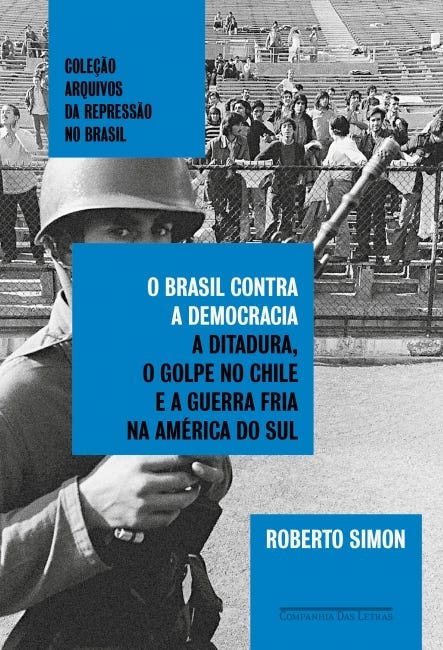
Roberto Simon’s O Brasil contra a democracia: a ditadura, o golpe no Chile e a Guerra Fria na América do Sul is one the newest and finest additions to the long and impressive list of books on the international history of the crisis of Chilean democracy its final destruction by the military in 1973, and the dictatorship that ruled over the country until 1990. The relatively large size of this body of literature, well known and referenced by Simon in his skillfully crafted narrative, reflects the massive international interest generated by the trajectory of Chilean politics in the Cold War. The “Chilean road to socialism” promised by Salvador Allende and his coalition fascinated a great many observers abroad, mostly because of the exceptional character of its strategy. The coup that overthrew Allende on 11 September 1973 and the military dictatorship that ruled over Chile until 1990, on the other hand, so horrified international public opinion that even allies of the Pinochet regime in the world of the Cold War felt that they should avoid any enthusiastic identification with the Chilean dictator. The attitude of Ernesto Geisel toward the attendance of Pinochet at his inauguration in 1974, vividly depicted by Simon (430–457), illustrates the latter point with precision.
A small country far removed from the greatest powers of the international system of the time, in the 1960s and 1970s Chile became a central stage of the Cold War. The crisis and destruction of Chilean democracy went hand in hand with an unprecedented — and unrepeated — involvement of foreign actors in its domestic politics. The United States, Brazil, Cuba, and the Soviet Union, to different degrees and with very different motivations, directed parts of their foreign policies, officially and covertly, to the Chilean political stage and attempted to affect its course in order to protect or promote their interests in the context of the Cold War and of the international system of the American continent (Fermandois, 1985; Haslam, 2005; Gustafson, 2007; Harmer, 2011; Ulianova and Fediakova, 1998; Kornbluh, 2003; Sigmund, 1993; Hurtado-Torres, 2020, among others).
So much has been written about the international history of Chile in the 1960s and 1970s that, superficially, it looks as if little more could be added to our large body of knowledge about the topic. With this book, Roberto Simon has proven such assumptions wrong. There is, after all, still a lot more to learn and say about the international history of the crisis and destruction of Chilean democracy, and Simon’s work offers a great contribution to that endeavor.
The involvement of the Brazilian military regime in Chilean politics in the years preceding the military coup of 1973 has been a known matter for almost anyone with a basic knowledge of the history of the period. In his seminal work about the international history of the Allende government, Joaquín Fermandois (1985) suggested that the involvement of Brazil in Chilean politics went further than the available sources at the time allowed to assert. The passage of time, with its effect on the professional study of history and, more specifically, the ability of scholars of international affairs to access diplomatic sources, has opened the way for a significant expansion and deepening of our knowledge about this theme. Tanya Harmer’s works (2011 and 2012) have exposed and explained a good deal of the motivations and decisions behind the South American policy of the Brazilian military regime, for which the situation of Chile was of paramount importance. Mila Burns (2016) has further contributed to the expansion of this body of literature focused on the involvement of Brazil in the political affairs of Chile.
Simon’s book, building on the abundant and significant literature published on the international history of Chile in the 60s and 70s published in Spanish, English, and Portuguese, offers an account of Brazil’s involvement in Chilean politics that will for some time be the most authoritative work on the subject. The author skillfully builds a narrative that weaves together events that took place mostly in Chile and Brazil, but also in Argentina, Uruguay, Bolivia, and Peru. The fundamental bilateral character of the story told by Simon thus becomes, unpretentiously yet effectively, a truly international history of South America in the years of the Brazilian military dictatorship.
The international, multilateral character of a story whose stellar actors were in Brasilia and Santiago is an appropriate reflection of the time in which the events narrated by Simon unfolded. The Cold War, as attested by its protagonists and students, in the past and the present, was defined by the assumption held by the authorities of major and minor powers that the national interests of their countries were at stake in the domestic politics of other countries, sometimes far beyond their geographic vicinities. Chile, a small country, with little geopolitical leverage, became nonetheless a focal point of the Cold War because the democratic constitution of its political system allowed for an open confrontation of forces closely identified with the ideologies and languages that gave shape to the bipolar order of the time. It was one thing for Marxists and other left-wing revolutionaries to achieve power and impose their rule through violence, war, and coercion; it was quite another to implement their radical projects of transformation through the means offered by a legitimate constitutional order. The triumph of the revolutionary left in Chile in the presidential election of 1970, therefore, was a matter of the greatest relevance for various international actors who assumed that the interests of their countries were in some way at stake in Chile (Hurtado-Torres, 2019).
The highest authorities of the Brazilian military regime, as well as many of its diplomatic representatives abroad, saw with great alarm the victory of Salvador Allende in the presidential election of 1970. As Simon (61) aptly shows, for the generals in charge in Brasilia, the possible implementation and consolidation of socialism in a South American country constituted a threat and, consequently, they decided that something had to be done about it. The reasoning behind this mindset, which Simon explains elegantly through a careful exposition and analysis of several official sources still understudied by scholars, presented many similarities with the domino theory notions that underlay so much of the U.S. foreign policy in the Cold War. These similarities notwithstanding, the foreign policy of the Brazilian military regime, as is convincingly demonstrated by Simon, developed independently from that of the United States, even as the interests of both countries regarding Chile and other countries of South America, such as Bolivia and Uruguay, converged.
Exposing and explaining the independence with which the Brazilian military regime read the country’s national interest and, more importantly, devised and implemented its foreign policy is one of the greatest strengths of Simon’s book. Without engaging in contrived theoretical discussions about the entity and pertinence of concepts such as empire or hegemony, the author demonstrates that Brazil’s foreign policy during the military dictatorship, in all its expressions, followed fundamentally — and almost exclusively — from decisions made independently by the higher echelons of power in Brasilia. Even at times when the views of the Brazilian regime and the U.S. government coincided almost perfectly, as in the cases of their opposition to Allende, the Uruguayan left, or the Juan José Torres regime in Bolivia, their actions proceeded independently. The point has been made before by other scholars, so Simon’s argument must not be overestimated in its essential originality (Harmer, 2011 and 2012). On the other hand, Simon’s detailed account of the process of decision-making and implementation of Brazil’s foreign policy, especially under Medici, based on a wealth of Brazilian and U.S. sources, provides scholars and other interested readers with a thorough reconstruction and explanation of the process under assessment. In this sense, one could say, perhaps simplifying a little, that in O Brasil contra a democracia the narrative is the argument. To the extent that Simon is successful in his endeavor, which I think is the case, a book like this could very well call into question some of the ways in which international history is communicated through the formats that have become the norm in academia.
A second element of the internationalization of political history in South America in the 1960s and 1970s is the prevalence of military rule in the countries of the region. In the nine years that followed the Brazilian military coup that overthrew Joao Goulart in 1964, all other Latin countries of South America, except for Colombia, Venezuela, and Paraguay, whose government was already unipersonal and authoritarian, experienced military coups and regimes. Somewhat paradoxically, the armed forces of the different countries of the region had established international links and networks of communication that facilitated the convergence of ideas and individuals and, as a result, created the conditions for the formation of alliances oriented toward the intervention of the military in the political affairs of their countries. For all the talk about Latin American and Third World solidarity among revolutionaries and other actors of radical sensibilities, none of their international and transnational endeavors achieved the ideological cohesion and operational capabilities that the armed forces of the region were able to sustain, especially when most of them ruled over their countries in the 1970s.
This network of military relationships, developed through formal and informal means, such as the personal friendships established between officers of different countries over shared ideas and interests, lay the ground for the formation of alliances in a more concrete manner and with great consequences. Simon shows how Brazilian officers, as well as diplomats who adhered zealously to the line of the military regime, cultivated their counterparts in other South American countries. In the case of Chile, these relationships permitted the clear implementation of an anticommunist foreign policy even in the presence of an ideologically distant government such as Allende’s. Once the military overthrew Allende in 1973, the work of the previous years opened the way for a significant influence of the Brazilian military regime in Chile, which, besides the natural ideological affinity between intransigent anti-communist governments, included the expansion of commercial relations in favor of Brazil, the provision of arms and other military hardware for the isolated Pinochet regime, the training of Chilean officers of the secret police in Brazilian schools, and the cooperation of both regimes in the repression of dissent across the region. To different degrees, the Brazilian military’s cultivation of officers of other armed forces of the region rendered positive results for Brasilia in the cases of Bolivia and Uruguay as well.
The prevalence of military rule also entailed a heightened sense of fear and perception of threats in South America, an issue that is perhaps not so clearly identified in Simon’s book, even though the narrative includes most of the events that highlighted this situation. The Brazilian generals brought to power with them a view of the international situation of the continent in which the sense of peril entailed by the rise of revolutionary challenges underlay a great deal of their policymaking. They consequently decided to make their best efforts to check a tide that they considered a mortal threat to their interest as ruling elite but also, and mostly, to what they deemed the essential interest of their country. This is the line of thinking that led the Medici government to intervene in the affairs of Chile, Uruguay, and Bolivia. In the same vein, the foreign policies of all the other countries ruled by the armed forces in the sixties and seventies were defined by the comprehension of the national interest assumed corporately by the military. This is the reason why, besides the ideological affinities that brought together most of the military regimes of the region — the Peruvian Revolutionary Government of the Armed Force was the exception — the most outstanding characteristic of the international history of South America in the 1970s was a generalized sense of the imminence of an international conflict. Such a conflagration could have erupted because of territorial controversies between Argentina and Chile on the Beagle Channel, Peru, and Ecuador over their disputed border in the Amazonian region, or Peru and Chile over the former’s historic disconformity with the settlement of the War of the Pacific in the nineteenth century. In these situations, ideological differences and affinities were less relevant than the more traditional view of the national interest, determined mostly by issues of borders and territorial sovereignty, held with great zeal by the military in all the countries involved (Hurtado-Torres and Fermandois, 2020). To a large extent, the matter of the Itaipu dam (210, 243), which caused some friction between Argentina and Brazil in the 1970s but was eventually settled by an accord between the military governments of both countries and Paraguay in 1979, belonged in this reality of widespread geopolitical tensions created by the prevalence of military rule in the region.
Roberto Simon joins in and greatly contributes to a large collective effort, by researchers in Chile, Brazil, the United States, and Europe, to uncover a history that many of its protagonists would have preferred to keep in the dark. As Simon correctly points out at the end of the book (570), the normalization of relations between Brazil and Chile occurred, and not by mere coincidence, when both countries resumed democratic practice. That step forward certainly changed the character of the relationship between the governments of both countries. But it also made possible the very effort on which we are here embarked. Simon’s outstanding book, as has been the case of all the research projects conducted by some of us, was possible because the democratic character of the societies in which we live and work has made access to records a matter of principle and policy. Of course, there is still a lot to do in that regard and there is still much that we do not know about the most secret and most atrocious deeds of the military dictatorships that ruled over most South American countries in the 1970s. However, what we do know and expose about those times have come mostly from the records left by decision-makers and functionaries in those societies that maintained or resumed democratic practices after the end of the Cold War — Brazil and Chile among them. Whatever we know about Soviet and Cuban involvement in the South American Cold War comes from a very small set of written sources and a few testimonies of agents of the foreign policies of those countries that, inevitably, leave much unsaid. Ultimately, Simon’s book, based mostly on sources made available to him and other researchers by the institutional mechanisms of democracies in which public scrutiny is a common and legal practice, is a very fine work of scholarship, but also a product of a political culture that has allowed us to look back, explore, and expose much of the darkness in which our societies sank during the Cold War. Unfortunately, not all societies in Latin America have these possibilities.
References
Fermandois, Joaquín (1985) Chile y el mundo 1970–1973. La política exterior del gobierno de la Unidad Popular y el sistema internacional. Santiago: Ediciones Universidad Católica de Chile.
Haslam, Jonathan (2005) The Nixon Administration and Allende’s Chile: A Case of Assisted Suicide. New York: Verso.
Gustafson, Kristian (2007) Hostile Intent: U.S. Covert Operations in Chile, 1964–1974. Washington D.C.: Potomac Books.
Harmer, Tanya (2011) Allende’s Chile and the Inter-American Cold War. Chapel Hill: The University of North Carolina Press.
Ulianova, Olga, and Eugenia Fediakova (1998) “Algunos aspectos de la ayuda financiera del Partido Comunista de la URSS al comunismo chileno durante la Guerra Fría.” Estudios Públicos, 72, Spring, pp. 113–148.
Kornbluh, Peter (2003) The Pinochet File: A Declassified Dossier on Atrocity and Accountability. New York: The New Press.
Sigmund, Paul (1993) The United States and Democracy in Chile. Baltimore: Johns Hopkins University Press.
Hurtado-Torres, Sebastián (2020) The Gathering Storm: Eduardo Frei’s Revolution in Liberty and Chile’s Cold War. Ithaca, NY: Cornell University Press.
Harmer, Tanya (2012) “Brazil’s Cold War in the Southern Cone, 1970–1975.” Cold War History, 12, 4, pp. 659–681.
Burns, Mila (2016) “Ditadura tipo exportação: a diplomacia brasileira e a queda de Salvador Allende,” História e Cultura, Franca, v. 5, n. 3, December, p. 175–198.
Hurtado-Torres, Sebastián (2019) “The Chilean Moment in the Global Cold War: International Reactions to Salvador Allende’s Victory in the Presidential Election of 1970”, Journal of Cold War Studies, Vol. 21, №3, Summer, pp. 26–55.
Hurtado-Torres, Sebastián and Joaquín Fermandois (2020) “The War that Didn’t Break Out: Military Rule and Regional Tensions in the Andes in the 1970s”, The International History Review, Vol. 42, Issue 5.
About the author
Sebastián Hurtado-Torres: Assistant professor, Instituto de Historia, Universidad San Sebastián, Santiago.