

It is estimated that more than 276 river basins are in the territories of more than one State (UN, 2012). In view of the central relevance of water resources for the most diverse social and economic activities, water sharing becomes an important element of international politics, giving rise to cooperation and conflict strategies. In this sense, it is important to remember that the action of each State on water will impact the way this resource will reach the territory of the other State. Cooperation, as a combination of preferences between States (KEOHANE; NYE, 1977), would therefore be the most correct solution for the governance of transboundary resources, in order to allow water security for all users.
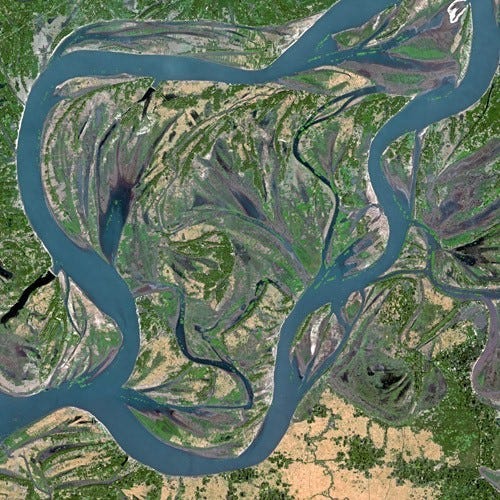
The Ganges-Brahmaputra-Meghna (GBM) transboundary river basin is located in Southeast Asia, encompassing India (64%), China (18%), Nepal (9%), Bangladesh (7%), and Bhutan (3% ) (FAO, 2011). The three rivers that make up the GBM basin have different characteristics and flow through different regions of the Indian subcontinent. The Brahmaputra River originates in Tibet, China, and flows South, where it reaches Indian territory, before reaching Bangladesh. The Brahmaputra River Basin occupies the territories of China (50.5%), India (33.6%), Bhutan (8.1%), and Bangladesh (7.8%), with a total of 83 million people living in these areas (YASUDA et al., 2017). The river system of the Brahmaputra River has great hydroelectric potential, fertile land, and water resources that are livelihoods for around 400 million people (YASUDA et al., 2017). In this sense, it can be understood that the basin is of great importance for economic and social development, in addition to being of paramount importance for the region’s ecosystems.
Water governance is the political, social, economic, and administrative systems involved in the management of water resources (ROGERS; HALL, 2003). The international conventions on transboundary waters — Water Convention 1992 and Watercourses Convention 1997 — proposed hydrographic basins to be managed in their entirety, through equitable, reasonable, and sustainable use by all users and the obligation to compensate for causing significant harm. In this sense, adequate governance of transboundary resources requires an important degree of trust between the actors, the promotion of an information, monitoring, and mutual alert system on physical and socioeconomic data related to waters, and the respective contingency and assistance plan in case of emergencies (UN, 2014; UNECE, 1992).
The governance of water resources in the Brahmaputra basin is part of a very troubled geopolitical context. The 20th century was marked by various conflicts between India and neighboring countries, due to the decolonization process, separatist movements, border disputes, and the search for hegemony over the region between India and China (DALDEGAN; BRETANHA; RUDRIGUES, 2022). In this context, the practice of cooperation mostly takes place bilaterally between riparian States, which makes it difficult to organize a common multilateral agreement on transboundary waters.
In 1949, the Indian-Bhutan Friendship Treaty was signed, which was the first treaty between the Basin States (YASUDA et al., 2017). Since then, these states have maintained a good relationship, with the agreement being revised in 2007 after Bhutan became a democracy. India, in turn, has become a financial donor for the development of Bhutan and is a major commercial partner of this state (INOUE et al., 2004). China, on the other hand, has been dedicated to promoting economic and security development projects in countries such as Pakistan, Sri Lanka, Nepal, and Bangladesh (PAUL, 2019).
With regard to water resources, India and Bangladesh created the Joint River Commission in 1972, as both share 54 rivers in the context of the GBM basin delta. This commission allowed them to share hydrological data on flooding and monitoring of tributaries of the Brahmaputra. India and China signed a Memorandum of Understanding (MOU) to provide hydrological data on the Brahmaputra River to each other (YASUDA et al., 2017). These are the first attempts to build governance of shared water resources in the region. Despite these attempts, one can see the escalation of conflict over water resources, mainly due to China’s search for energy security and India’s search for water and food security. Large hydroelectric dam construction projects in the Brahmaputra river by China (NANDY, 2013) have intensified tensions, including with a greater concentration of military contingents in the region (MAHAPATRA, 2015).
The power disputes between India and China condition the possibilities of cooperation between the two countries and between them and the other riparian countries. The balance of power is a consequence of the distribution of power among States, which may have military or economic characteristics. States, therefore, compete to avoid harm to themselves and aspire to change the status quo in their favor (MEARSHEIMER, 2013). The context of relations between China and India stems from the process of transformation of the two countries into modern sovereign States: from 1947, for India, when it became independent from the British Empire; and, in 1949, for China, when the People’s Republic of China was constituted against the Republic of China, after the civil war. In the following decade, the two States coexisted peacefully, until the Sino-Indian War, in 1962, due to territorial disputes that are not resolved until today (DALDEGAN; BRETANHA; RUDRIGUES, 2022).
China’s rise is increasing in the world, showing signs of a search for global hegemony (PAUL, 2019). This preponderance in the system takes place, however, gradually: the country, before becoming a global hegemony, must reach regional hegemony in Asia. India, on the other hand, seeks regional hegemony over the Indian subcontinent. The Indian strategy to contain China has led the country to promote a certain alignment with US foreign policy in the region since the 2000s, especially in matters relating to Tibet. The action of the United States in the region is related to the containment strategy of China on a global scale (BARCELLOS, 2020).
These regional power disputes do not prevent India and China from interacting through the BRICS, G-20, and the Shanghai Cooperation Organisation (OSC), which reveals their common interest, as emerging countries, in increasing their bargaining power in multilateral forums, and also in strategies to contain the power of the United States over Asia. In addition, smaller States in the region take advantage of regional disputes between India and China to develop a policy of equidistance between regional powers, in order to obtain greater political advantages than would be feasible in a context of established hegemony (PAUL, 2019).
Sino-Indian disputes for hegemony and the pursuit of political benefits from hegemonic stability (GILPIN, 1987) over the region are reflected in the governance of water, which is a fundamental natural resource for the promotion of water, energy, and food security. From this perspective, China is in a more favorable context, since it is located upstream of the Brahmaputra basin, that is, the country holds a large part of the basin’s springs and the resources that travel through the country’s territory do not come from the riparians countries (FAO, 2011). In this sense, the sovereign use of water resources by China becomes strategic in contexts of power struggles and the promotion of domestic interests (MAHAPATRA, 2015).
In the case of India, at first, it would be possible to assume a more collaborative perspective, as the country is located downstream in the Brahmaputra basin. However, when analyzing the entire GBM system, the country also adopts a sovereign position on the water resources in its territory, since it concentrates a large part of the sources in this hydrographic region (FAO, 2011). In this sense, the use of these resources also favors the promotion of water, energy, and food security in the country to the detriment of a policy that favors the shared management of the basin’s resources with the riparian countries (MAHAPATRA, 2015).
Finally, when understanding the political characteristics of the region, it is perceived that the management of the Brahmaputra water resources is subject to the need of promoting the socioeconomic development of the countries, mainly from China and India, in a scenario of demographic pressure and water stress, and to the dynamics of international power, between powers vying for regional hegemony. From this perspective, there is little room for cooperation on water resources between these countries and, from the perspective proposed by the international conventions on transboundary water resources, there are no elements that make it possible to assume the existence of shared governance in the near future.
Note
This article was produced within the scope of the research “The management of water resources in Brazil, China and India: the performance of emerging countries in transboundary basins within the international framework of water governance and climate change”, financed by the Fundação de Amparo à Pesquisa de Minas Gerais (Fapemig) and linked to the Department of International Relations of PUC Minas.
References
BARCELLOS, João Miguel Villas-Bôas. A Índia como terceiro interessado na disputa de poder sino estadunidense. Conjuntura Global, v. 9, n. 1, 2020
DALDEGAN, William; BRETANHA, Julia Adriane Ferreira; RUDRIGUES, Julia Maria Soares Andrade. Balança De Poder Asiática: Uma Análise Das Relações Securitárias E De Defesa Sino-Indianas. Revista Conjuntura Global. v.11, n. 2 (2022).
FAO. Transboundary River Basin Overview — Ganges- Brahmaputra-Meghna, FAO, 2011.
GILPIN, Robert. The political economy of international relations. Princeton: Princeton University, 1987.
INOUE, K., MURAYAMA, M., RAHMATULLAH, M., & Centre for Bhutan Studies. (2004). Sub- Regional Relations in the Eastern South Asia: With Special Focus on Bangladesh and Bhutan (Joint Research Program Series №132).
KEOHANE, Robert Owen; NYE, Joseph S. Power and Interdependence. Nova Iorque, 1977.
MAHAPATRA, S. and RATHA, K. Sovereign States and Surging Water: Brahmaputra River between China and India. FEEM Working Paper №046, 2015. Available in: https://papers.ssrn.com/sol3/papers.cfm?abstract_id=2608825#
MEARSHEIMER, John. Structural Realism. In: DUNNE, Tim; KURKI, Milja; SMITH, Steve. International Relations Theory. Oxford University Press, 2013.
NANDY, Chandan. China conducted 3–4 nuclear blasts in Tibet in 2005 to divert Brahmaputra. The Times of India. Aug 29, 2013. Available in: <https://timesofindia.indiatimes.com/blogs/nandygram/china-conducted-3-4-nuclear-blasts-in-tibet-in-2005-to-divert-brahmaputra/> Accessed on Apr 29, 2023.
PAUL, T.V. When balance of power meets globalization: China, India and the small states of South Asia. Politics, 2019.
ROGERS, P.; HALL, A.W. EffectiveWater Governance; Global Water Partnership: Stockholm, Sweden, 2003; Volume 7.
UN. Convention on the Law of the Non-navigational Uses of International Watercourses. General Assembly, 1997. New York, 2014. Available in: https://legal.un.org/ilc/texts/instruments/english/conventions/8_3_1997.pdf Accessed on Feb 24, 2023.
UN. UN World Water Development Report 2012. 2012.
UNECE. Convention on the Protection and Use of Transboundary Watercourses and International Lakes. Helsinki, 1992. Genebra, 1992. Available in: https://unece.org/fileadmin/DAM/env/water/pdf/watercon.pdf Accessed on Feb 24, 2023.
YASUDA, Y; AICH, D; HILL, D; HUNTJENS, P; SWAIN, A. (2017) Transboundary Water Cooperation over the Brahmaputra River: Legal Political Economy Analysis of Current and Future Potential Cooperation. The Hague Institute for Global Justice.
About the authors
Bernardo Hoffman Versieux: Mestre em Relações Internacionais pela PUC Minas.
Guilherme Sarsur Bahia: Graduando em Relações Internacionais pela PUC Minas.